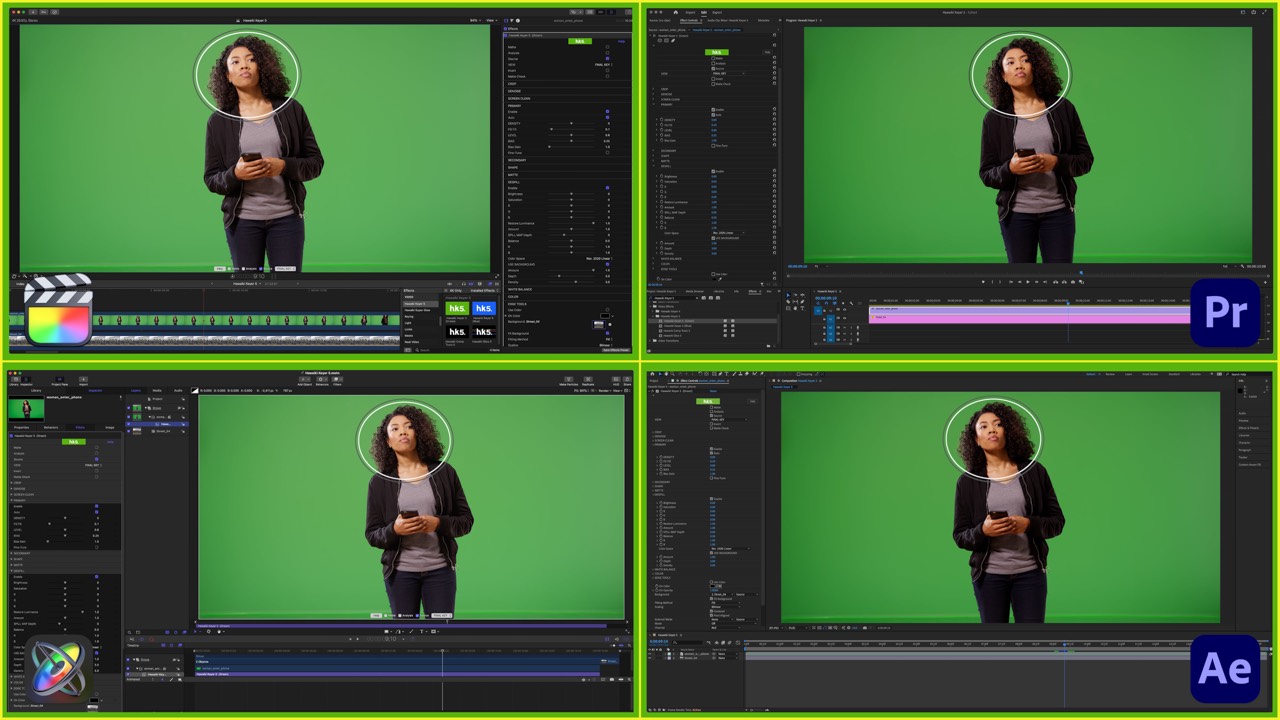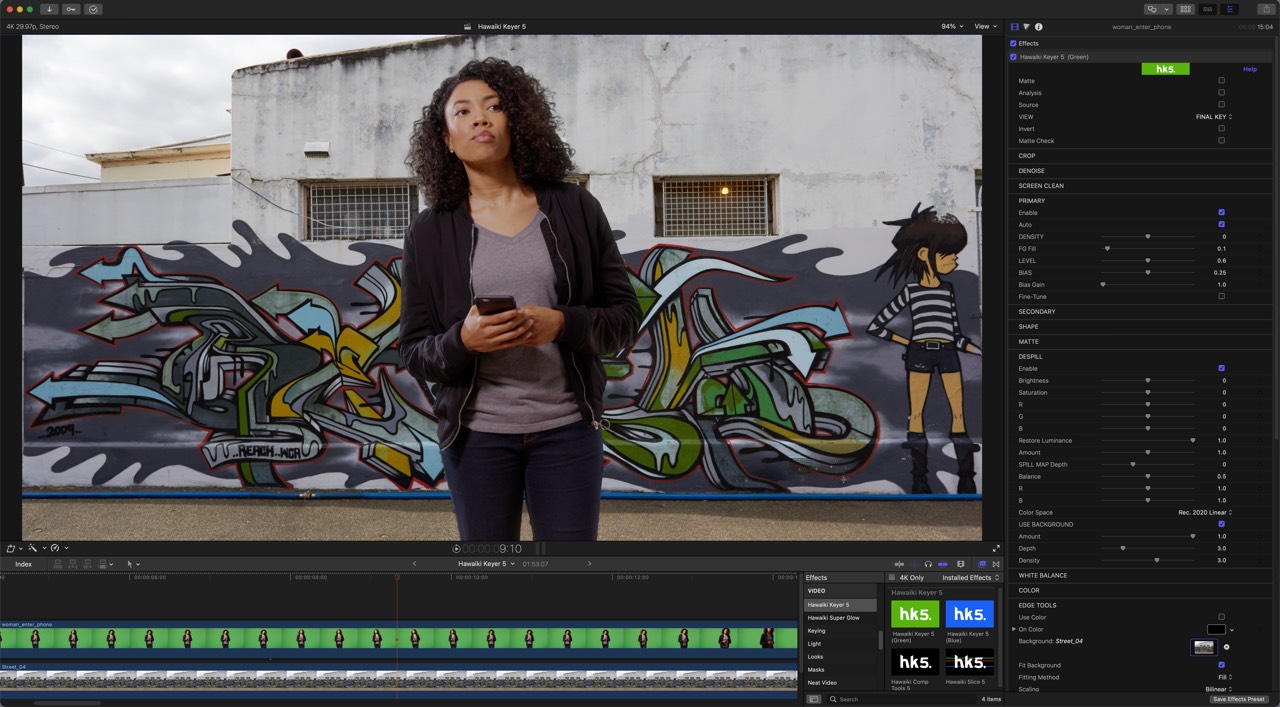
Hawaiki Keyer 5 - the industry’s most sophisticated Green & Blue Screen Keyer now with AI tracking
Hawaiki Keyer 5 builds on the best-in-class keying tools of Hawaiki Keyer 4 and enables you to use them more efficiently with even more powerful and intelligent tools for isolating your foreground.
It's easier than ever to maintain hair and other fine detail by creating secondary keys and dynamic garbage mattes with the new AI-powered face & object tracking and the new realtime edge tracking. And the new Crop tools allow you to exclude the edges of the screen and speed up the rendering of complex keys.
Refining your composite is faster and simpler with all the edge tools that were in a separate plug-in now integrated into Hawaiki Keyer. And we've expanded the compositing toolset with even more edge operations and the ability to resize and composite the background within the plug-in.
On top of this we've refined the UI and operation of the plug-in and optimized it for Apple silicon and HDR.
"For my money, these new features along with the depth of the adjustments available make Hawaiki Keyer 5 the best green/blue-screen keyer plug-in on the market." Oliver Peters - digitalfilms
Biology-how-life-works-by-morris-4th-edition -1... Info
According to Chapter 3 (Cell Structure and Function), Cilia’s outer surface was studded with thousands of tiny hairs that beat in synchronized waves, propelling her toward a cloud of bacteria. Her internal “instructions” came not from a mind, but from —the famous double helix described in Chapter 5 .
Inside a single drop of pond water, a young paramecium named Cilia drifted through a forest of algae. She had no brain, no eyes, no heart—yet she was alive, hungry, and searching. Biology-How-Life-Works-by-Morris-4th-Edition -1...
It sounds like you’re referencing the popular biology textbook by James Morris, Daniel Hartl, et al. (4th edition). The filename you started typing suggests you may have a digital copy (PDF/eBook) or are looking for something related to it—perhaps an interesting passage, figure, or chapter from the book. According to Chapter 3 (Cell Structure and Function),
If you’d like me to , here’s one inspired by its core themes (cell biology, evolution, genetics, and ecosystems): Title: The Wanderer and the Blueprint She had no brain, no eyes, no heart—yet
A hydra’s tentacle swept through the water. The other paramecium, lacking those epigenetic brakes, swam straight into its grasp. Cilia darted into a crevice, her tiny cilia beating a frantic retreat.
Later, as she divided asexually (Chapter 12), she passed those same epigenetic marks to her daughter. Evolution wasn’t just about random mutation, she seemed to whisper—it was also about the stories written on top of genes, passed down through the generations of the very small. If you meant something else by the filename (e.g., you’re missing part of a story, or you wanted a specific case study from the book), just paste the next few words you remember, and I’ll help build the narrative from there.
But here’s the twist: Cilia’s DNA was identical to that of the paramecium floating 50 micrometers to her left. Why, then, did she move differently? Because of (Chapter 17). Her great-grandmother had survived a viral attack, leaving chemical marks on her DNA that silenced certain ion-channel genes. That silent inheritance made Cilia slightly more cautious—and today, that caution saved her life.
macOS: macOS 14.7 Sonoma +, macOS 15 Sequoia +, macOS 26 Tahoe
FxFactory: 8.0.27 +
Apps: DaVincei Resolve 20 +, Final Cut Pro 10.6 +, Motion 5.6 +, Premiere Pro 22 +, After Effects 22 +